


Resources
Since 1969, California has required that all local governments (cities and counties) adequately plan to meet the housing needs of everyone in the community. California’s local governments meet this requirement by adopting housing plans as part of their “general plan” (also required by the state). General plans serve as the local government’s “blueprint” for how the city and/or county will grow and develop and include eight elements: land use, transportation, conservation, noise, open space, safety, environmental justice, and housing.
California’s Housing Element Law acknowledges that, in order for the private market to adequately address the housing needs and demand of Californians, local governments must adopt plans and regulatory systems that provide opportunities for (and do not unduly constrain) housing development. As a result, housing policy in California rests largely on the effective implementation of local general plans and, in particular, local housing elements.
The Housing Element identifies strategies and programs that focus on:
-
Conserving and improving existing housing
-
Maximizing housing opportunities throughout the community
-
Assisting in the provision of affordable housing
-
Removing governmental and other constraints to housing investment
-
Promoting fair and equal housing opportunities
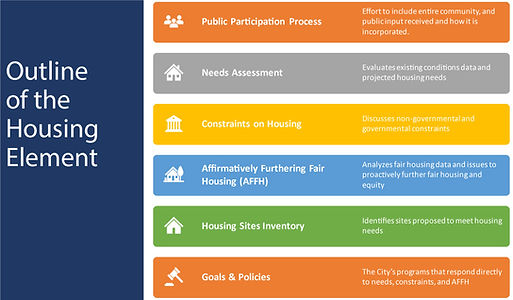
More information about how to create a comprehensive Housing Element can be found at the HCD website here: https://www.hcd.ca.gov/housing-element/building-blocks
Accessory Dwelling Unit or ADUs
If you would like to learn more about ADUs, please see the California Department of Housing and Community Development (HCD) guidebook that is linked here: https://www.hcd.ca.gov/sites/default/files/docs/policy-and-research/adu-handbook-update.pdf.

This guidebook is developed and maintained by HCD and serves as the interpretative guide to state ADU law. HCD also maintains a website with additional resources and information about ADUs: https://www.hcd.ca.gov/building-standards/adu.
If you are interested in adding an ADU on your property, please contact City Hall, (707) 668-5655 or cityclerk@bluelake.ca.gov.
More ADU Resources:
Humboldt County: https://www.humboldtadu.org/ and https://humboldtgov.org/3318/Approved-ADU-Plans. Building an ADU in Blue Lake is similar to the County.
Casita Coalition: https://www.casitacoalition.org/adu-info-center
Useful Terms and Definitions
(Taken from the City of Blue Lake's 6th Cycle 2019–2027 Housing Element Appendix: Glossary found in the Documents page. To comply with State housing element law it may be necessary to modify some of the following terms and definitions as part of the 7th Cycle Housing Element Update.)
Affordable Housing: Under State and federal statutes, housing which costs no more than 30 percent of gross household income. Housing costs include rent or mortgage payments, utilities, taxes, insurance, homeowner association fees, and other related costs. TRPA defines affordable housing as deed-restricted housing to be used exclusively for lower-income households (income not in excess of 80 percent of the county’s median income) and for very low-income households (income not in excess of 50 percent of the county’s median income), and with costs that do not exceed recommended state and federal standards.
Assisted Housing: Housing that has been subsidized by federal, state, or local housing programs.
California Department of Housing and Community Development (HCD): The State Department responsible for administering State-sponsored housing programs and for reviewing housing elements to determine compliance with State housing law.
CalHome Program: A grant program administered by HCD and awarded to local public agencies and nonprofits to be used to assist local homeownership programs aimed at lower and very-low income households in order to increase and maintain homeownership, encourage neighborhood revitalization and sustainable development, and maximize the use of existing homes.
Census: The official United States decennial enumeration of the population conducted by the federal government.
Community Development Block Grant (CDBG): A grant program administered by the U.S. Department of Housing and Urban Development (HUD) on a formula basis for entitlement communities, and by the State Department of Housing and Community Development (HCD) for non-entitled jurisdictions. This grant allots money to cities and counties for housing rehabilitation and community development, including public facilities and economic development.
Compatible: Capable of existing together without conflict or ill effects.
Condominium: A building or group of buildings in which units are owned individually, but the structure, common areas and facilities are owned by all owners on a proportional, undivided basis.
Consistent: Free from variation or contradiction. Programs in the General Plan are to be consistent, not contradictory or preferential. State law requires consistency between a general plan and implementation measures such as the zoning ordinance.
Contract Rent: The monthly rent agreed to, or contracted for regardless of any furnishings, utilities, or services that may be included.
Density: The number of dwelling units per unit of land. Density usually is expressed “per acre,” e.g., a development with 100 units located on 20 acres has density of 5.0 units per acre.
Density, Residential: The number of permanent residential dwelling units per acre of land. Densities specified in the General Plan may be expressed in units per gross acre or per net developable acre.
Density Bonus: The allocation of development rights that allows a parcel to accommodate additional square footage or additional residential units beyond the maximum for which the parcel is zoned. Under Government Code Section 65915, a housing development that provides 20 percent of its units for lower income households, or ten percent of its units for very low-income households, or 50 percent of its units for seniors, is entitled to a density bonus and other concessions.
Developable Land: Land that is suitable as a location for structures and that can be developed free of hazards to, and without disruption of, or significant impact on, natural resource areas.
Development Impact Fees: A fee or charge imposed on developers to pay for a jurisdiction’s costs of providing services to new development.
Development Right: The right granted to a land owner or other authorized party to improve a property. Such right is usually expressed in terms of a use and intensity allowed under existing zoning regulation. For example, a development right may specify the maximum number of residential dwelling units permitted per acre of land.
Dwelling, Multi-family: A building containing two or more dwelling units for the use of individual households; an apartment or condominium building is an example of this dwelling unit type.
Dwelling, Single-family Attached: A one-family dwelling attached to one or more other one-family dwellings by a common vertical wall. Row houses and town homes are examples of this dwelling unit type.
Dwelling, Single-family Detached: A dwelling, not attached to any other dwelling, which is designed for and occupied by not more than one family and surrounded by open space or yards.
Dwelling Unit: A room or group of rooms (including sleeping, eating, cooking, and sanitation facilities), that constitutes an independent housekeeping unit, occupied or intended for occupancy by one household on a long-term basis.
Element: A division or chapter of the General Plan.
Emergency Shelter: An emergency shelter is a facility that provides shelter to homeless families and/or homeless individuals on a limited short-term basis.
Encourage: To stimulate or foster a particular condition through direct or indirect action by the private sector or government agencies.
Enhance: To improve existing conditions by increasing the quantity or quality of beneficial uses or features.
Family: (1) Two or more persons related by birth, marriage, or adoption [U.S. Bureau of the Census]. (2) An individual or a group of persons living together who constitute a bona fide single-family housekeeping unit in a dwelling unit, not including a fraternity, sorority, club, or other group of persons occupying a hotel, lodging house or institution of any kind [California].
Feasible: Capable of being accomplished in a successful manner within a reasonable period of time, taking into account economic, environmental, social, and technological factors.
General Plan: The General Plan is a legal document, adopted by the legislative body of a City or County, setting forth policies regarding long-term development. California law requires the preparation of seven elements or chapters in the General Plan: Land Use, Housing, Circulation, Conservation, Open Space, Noise, and Safety. Additional elements are permitted, such as Economic Development, Urban Design and similar local concerns.
Goal: The ultimate purpose of an effort stated in a way that is general in nature and immeasurable.
Gross Rent: Contract rent plus the estimated average monthly cost of utilities (water, electricity, gas) and fuels (oil, kerosene, wood, etc.) To the extent that these are paid for by the renter (or paid for by a relative, welfare agency, or friend) in addition to the rent.
Group Quarters: A facility which houses groups of unrelated persons not living in households (U.S. Census definition). Examples of group quarters include institutions, dormitories, shelters, military quarters, assisted living facilities and other quarters, including single-room occupancy (SRO) housing, where 10 or more unrelated individuals are housed.
Homeless: Unsheltered homeless are families and individuals whose primary nighttime residence is a public or private place not designed for, or ordinarily used as, a regular sleeping accommodation for human beings (e.g., the street, sidewalks, cars, vacant and abandoned buildings). Sheltered homeless are families and persons whose primary nighttime residence is a supervised publicly or privately operated shelter (e.g., emergency, transitional, battered women, and homeless youth shelters; and commercial hotels used to house the homeless).
Household: All those persons—related or unrelated—who occupy a single housing unit.
Household Income: The total income of all the persons living in a household. A household is usually described as very low income, low income, moderate income, and upper income based upon household size, and income, relative to the regional median income.
Housing and Community Development, Department of (HCD): The State agency that has principal responsibility for assessing, planning for, and assisting communities to meet the needs of low- and moderate-income households.
Housing and Urban Development, U.S. Department of (HUD): A cabinet-level department of the federal government that administers housing and community development programs.
Housing Authority, Local (LHA): Local housing agency established in State law, subject to local activation and operation. Originally intended to manage certain federal subsidies, but vested with broad powers to develop and manage other forms of affordable housing.
Housing Unit: The place of permanent or customary abode of a person or family. A housing unit may be a single-family dwelling, a multi-family dwelling, a condominium, a modular home, a mobile home, a cooperative, or any other residential unit considered real property under State law. A housing unit has, at least, cooking facilities, a bathroom, and a place to sleep. It also is a dwelling that cannot be moved without substantial damage or unreasonable cost.
Impact Fee: A fee, also called a development fee, levied on the developer of a project by a city, county, or other public agency as compensation for otherwise-unmitigated impacts the project will produce.
Implementation Program: An action, procedures, program, or technique that carries out general plan policy. Implementation programs also specify primary responsibility for carrying out the action and a time frame for its accomplishment.
Income Category: Four categories are used to classify a household according to income based on the median income for the county. Under state housing statutes, these categories are defined as follows: Very Low (0-50% of County median); Low (50-80% of County median); Moderate (80-120% of County median); and Upper (over 120% of County median).
Infill Development: Development of vacant land (usually individual lots or left-over properties) within areas that are already largely developed.
Large Household: A household with 5 or more members.
Manufactured Housing: Housing that is constructed of manufactured components, assembled partly at the site rather than totally at the site. Also referred to as modular housing.
Median Income: The annual income for each household size within a region which is defined annually by HUD. Half of the households in the region have incomes above the median and half have incomes below the median.
Mitigate: To ameliorate, alleviate, or avoid to the extent reasonably feasible.
Mixed-use: Properties on which various uses, such as office, commercial, institutional, and residential, are combined in a single building or on a single site in an integrated development project with significant functional interrelationships and a coherent physical design. A “single site” may include contiguous properties.
Mobile Home: A structure, transportable in one or more sections, built on a permanent chassis and designed for use as a single-family dwelling unit and which (1) has a minimum of 400 square feet of living space; (2) has a minimum width in excess of 102 inches; (3) is connected to all available permanent utilities; and (4) is tied down (a) to a permanent foundation on a lot either owned or leased by the homeowner or (b) is set on piers, with wheels removed and skirted, in a mobile home park.
Multi-family Dwelling Unit: A building or portion thereof designed for or occupied by two or more families living independently of each other, including duplexes, triplexes, quadplexes, apartments, and condominiums.
Overcrowding: Households or occupied housing units with 1.01 or more persons per room.
Parcel: A lot in single ownership or under single control, usually considered a unit for purposes of development.
Poverty Level: As used by the U.S. Census, families and unrelated individuals are classified as being above or below the poverty level based on a poverty index that provides a range of income cutoffs or “poverty thresholds” varying by size of family, number of children, and age of householder. The income cutoffs are updated each year to reflect the change in the Consumer Price Index.
Quantified Objective: The housing element must include quantified objectives which specify the maximum number of housing units that can be constructed, rehabilitated, and conserved by income level within a five- year time frame, based on the needs, resources, and constraints identified in the housing element (§65583 (b)). The number of units that can be conserved should include a subtotal for the number of existing assisted units subject to conversion to non-low-income households. Whenever possible, objectives should be set for each particular housing program, establishing a numerical target for the effective period of the program. Ideally, the sum of the quantified objectives will be equal to the identified housing needs. However, identified needs may exceed available resources and limitations imposed by other requirements of state planning law. Where this is the case, the quantified objectives need not equal the identified housing needs, but should establish the maximum number of units that can be constructed, rehabilitated, and conserved (including existing subsidized units subject to conversion which can be preserved for lower- income use), given the constraints.
Regional Housing Needs Plan (RHNP): The Regional Housing Needs Plan (RHNP) is based on State of California projections of population growth and housing unit demand and assigns a share of the region’s future housing need to each jurisdiction within the AMBAG (Association of Monterey Bay Area Governments). These housing need numbers serve as the basis for the update of the Housing Element in each California city and county.
Regional Housing Needs Share: A quantification by a COG or by HCD of existing and projected housing need, by household income group, for all localities within a region.
Rehabilitation: The repair, preservation, and/or improvement of substandard housing.
Residential, Multiple Family: Usually three or more dwelling units on a single site, which may be in the same or separate buildings.
Residential, Single-family: A single dwelling unit on a building site.
Rezone: An amendment to the map and/or text of a zoning ordinance to effect a change in the nature, density, or intensity of uses allowed in a zoning district and/or on a designated parcel or land area.
Second Unit: A self-contained living unit, either attached to or detached from, and in addition to, the primary residential unit on a single lot. “Granny Flat” is one type of second unit intended for the elderly.
Seniors: Persons age 65 and older.
Shall: That which is obligatory or necessary.
Should: Signifies a directive to be honored if feasible.
Site: A parcel of land used or intended for one use or a group of uses and having frontage on a public or an approved private street. A lot.
Special Needs Groups: Those segments of the population which have a more difficult time finding decent affordable housing due to special circumstances. Under California Housing Element statutes, these special needs groups consist of the elderly, handicapped, large families, female-headed households, farmworkers and the homeless. A jurisdiction may also choose to consider additional special needs groups in the Housing Element, such as students, military households, other groups present in their community.
Subdivision: The division of a tract of land into defined lots in accordance with the Subdivision Map Act, either improved or unimproved, which can be separately conveyed by sale or lease, and which can be altered or developed.
Subsidize: To assist by payment of a sum of money or by the granting of terms or favors that reduce the need for monetary expenditures. Housing subsidies may take the forms of mortgage interest deductions or tax credits from federal and/or state income taxes, sale or lease at less than market value of land to be used for the construction of housing, payments to supplement a minimum affordable rent, and the like.
Substandard Housing: Residential dwellings that, because of their physical condition, do not provide safe and sanitary housing.
Supportive Housing: Housing with a supporting environment, such as group homes or Single Room Occupancy (SRO) housing and other housing that includes a supportive service component such as those defined below.
Supportive Services: Services provided to residents of supportive housing for the purpose of facilitating the independence of residents. Some examples are case management, medical or psychological counseling and supervision, child care, transportation, and job training.
Transitional Housing: Transitional housing is temporary (often six months to two years) housing for a homeless individual or family who is transitioning to permanent housing. Transitional housing often includes a supportive services component (e.g. job skills training, rehabilitation counseling, etc.) to allow individuals to gain necessary life skills in support of independent living.
U.S. Department of Housing and Urban Development (HUD): The cabinet level department of the federal government responsible for housing, housing assistance, and urban development at the national level. Housing programs administered through HUD include Community Development Block Grant (CDBG), HOME and Section 8, among others.
Vacant: Lands or buildings that are not actively used for any purpose.
Zoning: The division of a city or county by legislative regulations into areas, or zones, which specify allowable uses for real property and size restrictions for buildings within these areas; a program that implements policies of the General Plan.
Blue Lake City Hall
111 Greenwood Ave
Blue Lake, CA 95525
(707) 668-5655
cityclerk@bluelake.ca.gov
City Council Meetings
There will be multiple opportunities to see the document presented and studied at City Council Meetings.
City Council Meeting are held in-person at the Skinner Store, located behind City Hall at 111 Greenwood Road on the 4th Tuesday at 6:30 PM. Public participation via Zoom is also available. Zoom information is provided via the Council agenda. Please contact City Hall for accessibility accommodations.
To contact the Housing Element Update Team directly, use the red "Write Us" button below.